July 24, 2025
Robert Combas
Interview by Maria João Fernandes
It is a privilege to listen to one of the protagonists of contemporary art, creator of a movement that influenced the course of contemporary figuration, liberated from all prejudices of submission to appearances, in an intercultural vision integrating emblematic strands of today’s culture and an urban experience, such as comic strips, graffiti, science fiction, pop and rock culture, along with popular culture and children’s drawings.
How would you define in the first person the “figuration libre” movement that you founded in the 1980s with Hervé Di Rosa, Ben and other artists?
It was the artist Ben who coined the name Figuration Libre. It corresponded to the kind of painting we were doing. We were young outsiders who loved rock, the underground, popular cultures, art brut, the magazine Harakiri… We came from Sète, from working‑class backgrounds. At the end of the 1970s, with Hervé Di Rosa and Ketty Brindel, we created the magazine BATO – “an assemblagist art magazine made by hand, 100 copies” – which brought together various participants and revealed our taste for the absurd, the off‑beat, the poorly drawn, poorly painted. In parallel, I founded the musical group Les Démodés with Ketty Brindel and Richard Di Rosa, known as "Buddy". That group was also, for me, a manifesto of this free creation. We weren’t musicians, but that didn’t stop us from making music. We wanted to impose our flaws without complexes, so they would become strengths. That is a bit what Figuration Libre is: doing with what one has, which at the time was very little, but doing it with seriousness, a lot of work and ambition.
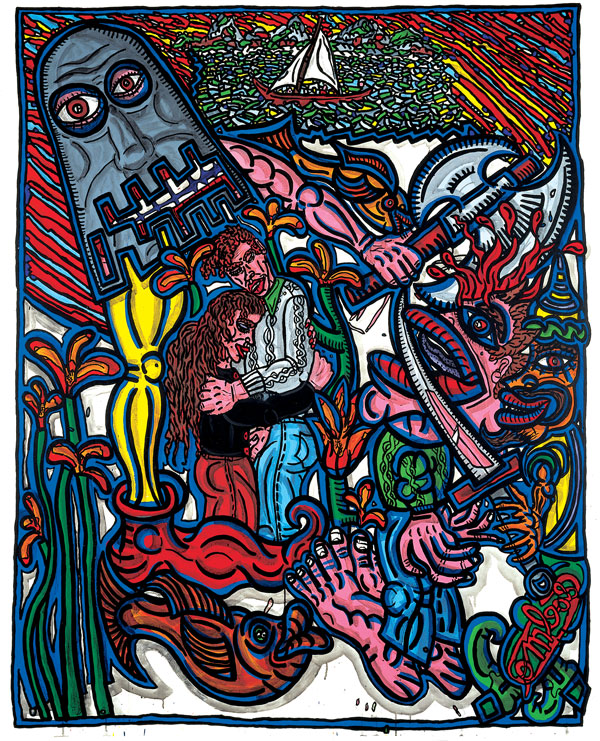
Robert Combas, “The Dream Paradise + Nightmare”, 1988, acrylic on canvas, 198 × 148 cm
You have been attributed various influences such as those of the American artists Keith Haring and Jean‑Michel Basquiat, which at times you contest. What are your acknowledged influences, if any, in painting or literature? What do your tributes to Matisse and Toulouse‑Lautrec or the reference to Van Gogh tell us in this regard? Where does your highly personal and original system of representation originate?
How can one be influenced by artists who appeared after us? In 1980, I completed my diploma in Saint‑Étienne. Bernard Ceysson, then director of the Saint‑Étienne museum, noticed me and invited me to participate in the autumn of 1980 in the exhibition “Après le classicisme”, which presented emerging movements returning to figuration in Germany, Italy, France, and the USA. Artists shown included David Salle, Francesco Clemente, Julian Schnabel… Keith Haring and Jean‑Michel Basquiat had not yet emerged! Even institutions, which should uphold historical truth, contributed to us being viewed as lesser versions of the Americans — this is something that weighs heavily on us. We shared with those American graffiti painters common concerns like music, public engagement, the desacralization of art, drugs (we can say it now)… In France, we couldn’t compete with America’s economic power, and rap culture became associated with that American painting. They were shooting stars; they died very young, like icons. We had to live, endure, learn to age. And it’s not easy to age with our painting. The other painters you mention are major masters to whom I pay tribute through exhibitions or paintings, but with whom I do not compare myself.
My painting is rock, I have said it and I continue to say it.
You have always privileged your connection with music, even stating “ma peinture, c’est du rock”, and recall in this respect the title of your 2012 exhibition in Lyon: _Greatest Hits_. How does this passion for music reflect in your work?
My painting is rock, I have already said it and I continue to say it. My painting is free; it is very rare that I make preparatory sketches, I don’t know where I’m going, there is much improvisation, but I start from a solid rhythmic base, which comes from my energy and craft, and a melodic line, which is the narrative. I think I can say, without pretension, that I am the painter who has addressed the widest range of themes (sacred, trivial, imaginary, historical…). Since the early 2010s, I have continued to play music with my rock group and visual performances Les Sans Pattes (with Lucas Mancione, and more recently with Lionel Martin, Marc Duran and Olivier Chambriard). Music and painting are fully intertwined in these performances, where images of my paintings are projected on stage and onto our bodies.
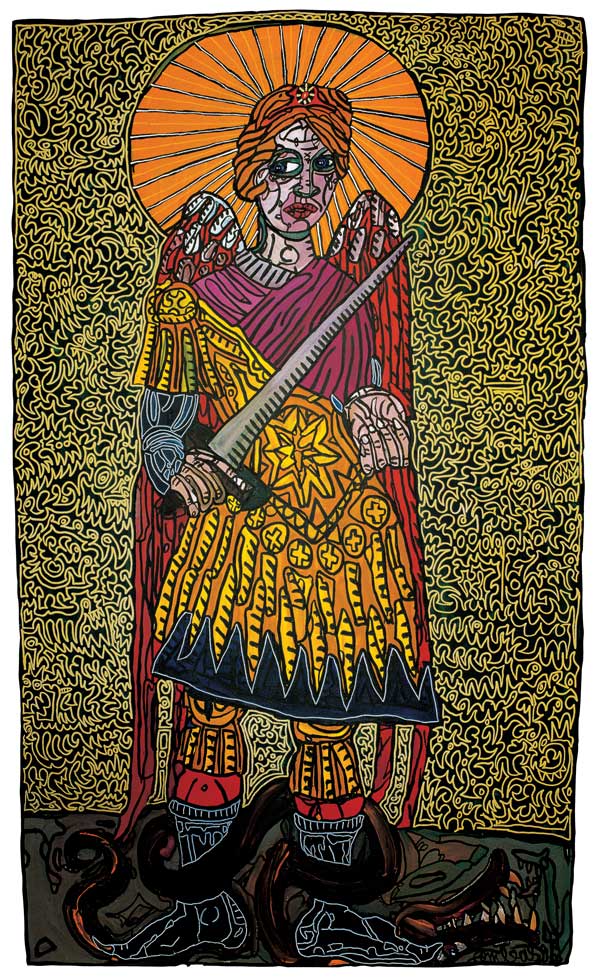
Robert Combas, “The Archangel – He who defeated the dragon of the Apocalypse and cast Lucifer to Earth”, 1995, acrylic on canvas, 210 × 127 cm
You are unanimously considered a major link to an urban space. How would you define your relationship with nature?
There are no rules. My painting draws more from urban influences, from society, but I am not a street artist. I entered art school at nine years old in Sète, and graduated at 23. We brought art to the street, but we didn’t paint on the street. Similarly, I like art brut, I feel close to it in my way as an artist, but I am not a practitioner of art brut. I’ve painted flowers and animals forever. And even more since I have been living mostly in Sète — that dates back to the early 2010s. Because the garden around my house and studio is lush. That profusion of flowers joins the profusion of weapons and the clashes of my battles. But also the profusion of the feminine sexes: petals, pistils, sepals, stamens… War and Love.
What is the meaning of the evolution of your work, from the early series “Battles” of 1977, Mickey Mouse and “Arab Pop Art”, through such remarkable works as _Le Fakir_ (1982, Toulon Museum of Art), _Le Phoenix Contemporain_ (1989), or _The Archangel_ (2010)? In other words, where are your style and worldview heading?
My painting evolves and "de-evolves" at the same time. When I start a painting, I have the impression that I’ve forgotten everything and no longer know how to do anything. All themes interest me, without hierarchy. Everything can be the subject of painting. I would like to find new paths, not be imprisoned by the black outline that is my trademark. I still hope to achieve that.
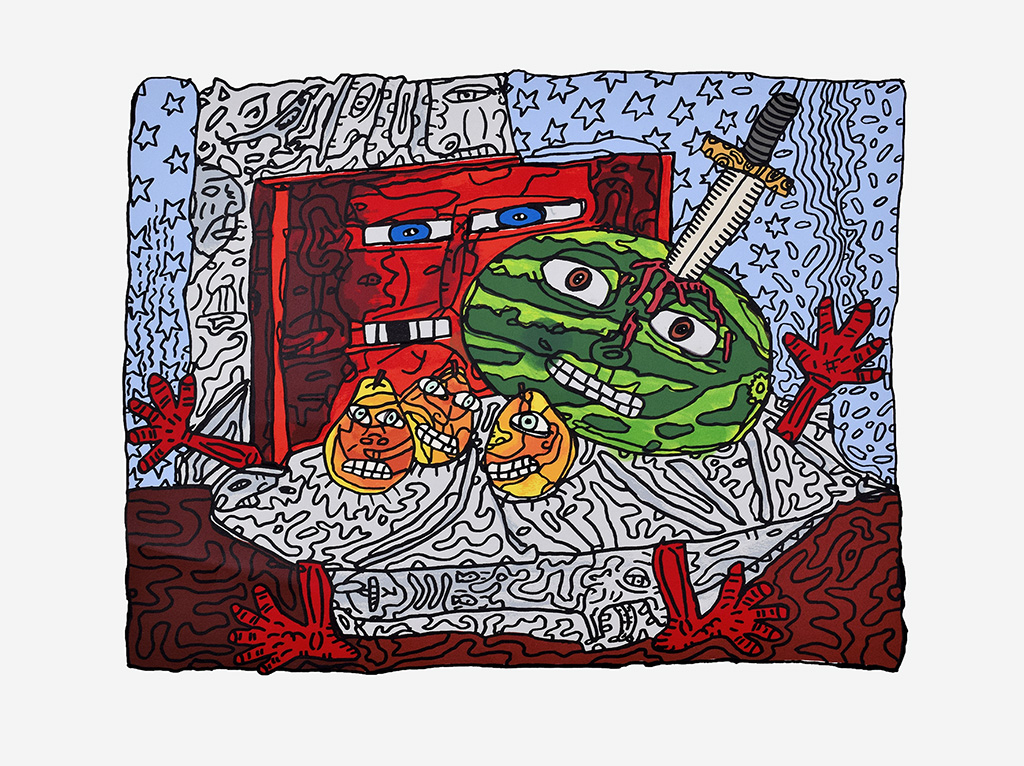
It is a living still life. Violence is present because everything we might consider beautiful and peaceful is threatening or threatened.
In the very particular context of your painting, what do you think you capture in your images?
My friend Michel Onfray wrote, in the book _Un chaman nommé Combas_, that I was a seismograph. I like that definition. I believe I capture sensations, intuitions, emotions, pulsations that need to be translated into my paintings.
War is a recurring theme in your painting. Can you explain why?
Love is central in my work and in my life. I feel close to romanticism, even if that surprises. And I have been painting battles forever because war is always present somewhere. And, for a painter, battle is a complete theme: life and death, the body, fear, cruelty, suffering… It is also a way to confront history, historical painting, art history. My painting has become more complex over time, it is not binary, everything merges and intertwines. I also have a true taste for details, costumes, weapons, armor, ornaments. The theme of battle is perfect for my painting.
EDIT: CPS
Robert Combas, “The Fruit Festival. Three pears, a watermelon and a wooden box! The wooden head broke a tooth eating bitter almonds”, screenprint, 56 × 69 cm, Edition of 100 copies, 2025
Has everything already been explored in art? What remains for you to do and say?
I don’t know what remains to be said in art. Some arts endure, others are quickly forgotten. We are not the ones who decide. I continue to be a man of the 20th century, I do not like this digital world. I seek to remain true to myself, with the modest means I have, continue working and being honest.
What does the distinction between abstraction and figuration mean to you, and what about the entry into artistic creation of the digital universe?
I don’t believe more in figuration than in abstraction. What matters is the power of the works. With new technologies, everyone will want to become an artist. It is a profession with a future.
Does your painting obey the logic of a constructed universe despite the sensation of chaos it sometimes communicates? Do you agree?
My painting is not always chaos. I insist on giving a title to each piece – as if leaving a clue, a poetic hint.
Could your current edition for the Portuguese Center for Screenprinting represent a step toward closer ties with our country?
It is a living still life. Violence is present because everything we might think of as beautiful and peaceful is threatening or threatened.
Could this collaboration with the largest art publisher in our country pave the way to greater proximity with Portuguese culture?
I feel like a man of the South. My painting starts from color, from contrasts. It is human. It speaks about humans. It brings humans closer. It can speak to everyone.
Photograph of the artist: Geneviève Combas